Autism in the Early Years: A Practical Guide by Val Cumine & Julia Dunlop & Gill Stevenson
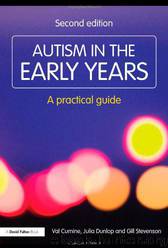
Author:Val Cumine & Julia Dunlop & Gill Stevenson [Cumine, Val & Dunlop, Julia & Stevenson, Gill]
Language: eng
Format: epub
Tags: General, Family & Relationships, Psychology, Education, Psychopathology, Preschool & Kindergarten, Special Education, Autism Spectrum Disorders, Learning Disabilities, Elementary, Communicative Disorders
ISBN: 9780415483735
Google: b2H9h_gnSvMC
Amazon: 0415483735
Publisher: Routledge
Published: 2009-12-14T00:00:00+00:00
duced to practical strategies to help them understand and manage the effects of autism on their child.
The programme aims to:
●
put parents in control to develop the potential of their child;
●
empower parents, and help them facilitate their child’s social communication and appropriate behaviour within
the child’s natural environment;
●
support parents in the period between diagnosis and school placement;
●
assist parents in establishing good practice in managing their child at an early age, preventing the development of
inappropriate behaviours.
What happens?
Throughout the series of workshops and home video sessions, parents are enabled to discuss aspects of autism and
practise effective strategies to encourage communication and support development, behavioural, social and inde-
pendence skills.
Groups of between four and six families work together with two trained professionals as workshop leaders over a
three-month period.
Application to autism
Early Bird was specifically developed for children on the autism spectrum and their families. Its main focus is to help
parents and carers to understand autism as it presents in their child.
52
Intervention within the EYFS
Evaluation
An early efficiency study examined the effectiveness of the model using outcome measures including both formal
assessments and collection of customer-satisfaction data.
Training is required to use the workshops and is provided by the NAS Early Bird Centre in South Yorkshire. The
three-day training course equips teams of multi-disciplinary professionals to deliver the parent programme under
licence to the NAS.
Enabling environments
The EYFS stresses the way in which environment plays a key role in supporting a child’s development. The impor-
tance of getting the environment right for the young child on the autism spectrum cannot be overemphasised.
TEACCH (Treatment and Education of Autistic and related Communication
handicapped CHildren)
TEACCH is a whole-life approach to helping people with autism, which aims to equip children for a productive life in
the community. It sets out to provide visual information, structure and predictability as it is recognised that the opti-
mum learning channel is visual.
It began in 1966 in North Carolina as a research project which was funded by the US government. The project,
led by Eric Schopler and colleagues, developed from clinical experience at the University of North Carolina. It was
established in 1972 as a state-wide programme. Since its foundation, Division TEACCH has worked with some 4,000
people with autism in North Carolina and has developed over the years in many parts of the world.
The University of North Carolina continues to be at the core, offering services and opportunities for training and
research, allowing easy access for clinicians and families to the latest developments. There is a comprehensive and
integrated service for families that facilitates access to assessment and intervention.
The approach requires that adaptations must occur in the three major areas of the child’s life: home, school and
community. Starting with a comprehensive assessment, the approach comprises a number of interconnected ele-
ments, which are based on structured teaching.
Structured teaching
PHySICAl STruCTurE
This refers to the way in which the environment is organised. There are clear visual boundaries segmenting the space
into recognisable parts. This helps the children understand what they are expected to do in each area. In the area set
aside for work, distractions are kept to a minimum.
THE SCHEdulE
This tells the child visually what activities
will occur and in which order.
Download
This site does not store any files on its server. We only index and link to content provided by other sites. Please contact the content providers to delete copyright contents if any and email us, we'll remove relevant links or contents immediately.
The Art of Coaching Workbook by Elena Aguilar(51413)
Trainspotting by Irvine Welsh(22027)
The Secret History by Donna Tartt(19507)
Twilight of the Idols With the Antichrist and Ecce Homo by Friedrich Nietzsche(18794)
All the Missing Girls by Megan Miranda(16828)
Cat's cradle by Kurt Vonnegut(15586)
Ready Player One by Cline Ernest(15174)
Talking to Strangers by Malcolm Gladwell(13577)
Fangirl by Rainbow Rowell(9494)
The remains of the day by Kazuo Ishiguro(9247)
The Compound Effect by Darren Hardy(9180)
Thirteen Reasons Why by Jay Asher(9155)
Tools of Titans by Timothy Ferriss(8631)
Periodization Training for Sports by Tudor Bompa(8435)
Wonder by R. J. Palacio(8295)
A Court of Wings and Ruin by Sarah J. Maas(8147)
The Lover by Duras Marguerite(8076)
Change Your Questions, Change Your Life by Marilee Adams(7949)
Giovanni's Room by James Baldwin(7603)
